
Understanding the resident’s functional status is vital for planning care while in the skilled nursing facility (SNF), as well as in planning for discharge. Functional scoring is currently used under the SNF Prospective Payment System (PPS) to classify payment groups. The Patient Driven Payment Model (PDPM) will continue to use resident function to determine reimbursement; however, PDPM makes changes to how the functional score is calculated.
Under RUG IV, Section G is used to define the score for function. As we move to PDPM, this will be determined through the coding of Section GG. PDPM will make no changes regarding how GG is coded, but accurate assessment and coding of this area will now be vitally important in the new reimbursement model. Fortunately, we have a few months to evaluate and enhance our coding skill and accuracy before the October 1, 2019 implementation date.
Section GG of the MDS gives us an opportunity to take an in-depth look into resident function. GG 0100 and 0110 help the interdisciplinary team to gain insight into the resident’s level of ability in everyday activities prior to the current illness or injury. This includes what device(s) were utilized in that previous setting to increase their level of independence. Knowledge of prior function is useful in working with the resident to determine appropriate goals for their time in the SNF, as well when planning for discharge.
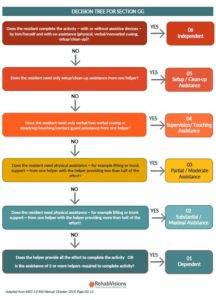
Section GG, items 0130-0170, is the area which will comprise the Functional Score for PDPM. The scoring of GG is in reverse to that of G, meaning that an increasing score is indicative of higher independence. Under PDPM, there is not a direct correlation between increased dependence and reimbursement. The change in scoring methodology was necessary to help the Centers for Medicare and Medicaid Services (CMS) standardize assessments across various payment settings.
GG is scored based upon the resident’s usual performance on days 1 through 3 of their SNF stay. This area should be completed prior to treatment interventions to get a true indication of the baseline performance. GG 0130-0170 should be coded based upon the observations and assessments of the interdisciplinary team and not based solely upon a therapy evaluation or single interaction with staff. This area should not be coded for the best nor the worst performance, but rather usual performance.
The CMS Manual for the Resident Assessment Instrument (RAI), specifically Chapter 3 for item-by-item coding, is the go-to for instruction for scoring of the MDS. The RAI Manual contains multiple scenarios and clarifications to assist qualified clinicians to code each item appropriately. The CMS webpage for the RAI manual contains information on the manual, including details on recent changes to document.
RehabVisions is your partner and we are here to assist with your therapy needs now and into the future. Stay with us as we countdown to PDPM together.
Click HERE to print this article.
This post is based upon details currently available from CMS at the time of publication. Please refer to the CMS PDPM page for more information.