
Welcome back to the sixth edition of the Countdown to PDPM. Today, we are looking at Non Therapy Ancillary (NTA) Classification. The series continues to build on prior postings on Patient Driven Payment Model (PDPM). If you missed any of those, or need to review, you can access them on the Resource site. From the home page, just scroll down the Archive menu on the right side of the screen view all prior editions.
The NTA component is determined using a four-step process. For the first step, you must determine whether resident has one or more NTA-related comorbidities.
A. Does the resident have HIV/AIDS?
B. Does the Resident Have the presence of Parenteral/IV Feedings? If so, determine whether these would be classified as High or Low intensity.
□ Refer to MDS item K0510A2 to see if the resident received parenteral/IV feeding during the last 7 days while a resident of the SNF. If the resident did not receive parenteral/IV feeding during the last 7 days while a resident, then the resident does not meet the criteria for this area. □ If the resident did receive parenteral/IV feeding during the last 7 days while a resident, then use item K0710A to determine if the proportion of total calories the resident received through parenteral or tube feeding was 51% or more while a resident (K0710A2 = 3). If K0710A2 =3 then the resident meets the criteria for Parenteral/IV Feeding – High Intensity. □ If the proportion of total calories the resident received through parenteral or tube feeding was 26-50% (K0710A2 = 2) and average fluid intake per day by IV or tube feeding was 501 cc per day or more while a resident (K0710B2 = 2), then the resident qualifies for Parenteral/IV Feeding – Low Intensity.
C. Does the resident have additional NTA-related comorbidities? This is determined in step two.
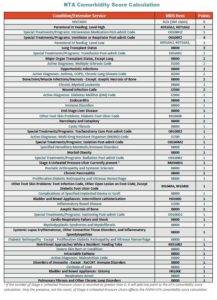
The second step is to calculate the resident’s total NTA score using the table below. Add the total points for all of the applicable comorbidities. If none of these conditions or services is present, the resident’s score is 0.
.
The third step is to determine the resident’s NTA group using the table below:

The fourth and final step is to apply the variable adjustment factor. The case-mix adjusted per diem rate for NTA groups is multiplied by the relevant variable per diem adjustment factor. For Medicare days 1-3, this is a factor of 3.0. For Medicare days 4-100, the adjustment factor is 1.0
RehabVisions is your partner, here to assist with your therapy needs now and into the future. Be sure to watch for our next post, as we take examine how the Nursing Component is obtained. Stay with us as we continue to countdown to PDPM together.
Click HERE to download a copy of this posting.
This post is based upon details currently available from CMS at the time of publication. Please refer to the CMS PDPM page for more information.