
Welcome back to the fifth installment of the Countdown to PDPM. The series continues to build on prior postings on Patient Driven Payment Model (PDPM). If you missed any of those, or need to review, you can access them here, on the Resource site. Just scroll down the Archive menu on the right side of the Resources home page to view all prior editions.
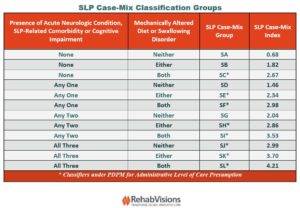
In this session, we will take an overview of how the Speech-Language Pathology (SLP) Component of the PDPM is calculated. The SLP component is determined using a combination of several factors. The presence of the Acute Neurologic clinical category, cognitive impairment, SLP-related comorbidity, swallowing disorders and, mechanically altered diets (MDS items K0100 and K0510C2) are all utilized to obtain the final SLP case-mix group and index.
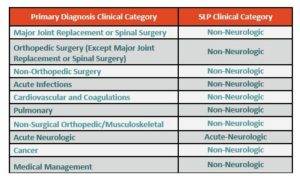
There are many diagnoses which constitute the Acute Neurologic Clinical Category. CMS has made a mapping of ICD-10 Diagnosis Codes for FY 2019 available, which makes up the various Clinical Categories. Click HERE to download that file.
A resident’s cognitive status is assessed using the Brief Interview for Mental Status (BIMS). The BIMS Summary Score is found under MDS item C0500. When the BIMS cannot be completed, the Staff Assessment for Mental Status (MDS C0700-C1000) is conducted and scored per RAI instructions. If neither the BIMS nor the Staff Assessment are completed, a PDPM cognitive level will be assigned as Cognitively Intact.
. Please refer to the PDPM Functional and Cognitive Scoring Fact Sheet for additional information regarding the determination of Cognitive Levels.
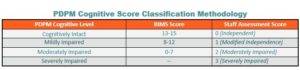
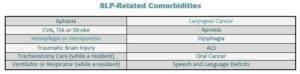
Determination of the presence of an acute neurologic condition is dependent upon whether the resident is classified into the Acute Neurologic clinical category. Any level of cognitive impairment is sufficient to qualify the patient for this aspect of classification. Any one or more SLP-related comorbidities qualifies.
Unlike the PT and OT components, SLP is not adjusted according to length of stay. The SLP Case-Mix Index remains constant.
At RehabVisions, we are dedicated to assisting you to prepare and thrive regardless of the reimbursement system. Our traditional values, innovative care and experience are resources that our partners can depend upon. Be sure to watch for our next post on the Non Therapy Ancillary Classification.
To download a copy of this posting, click HERE
This post is based upon details currently available from CMS at the time of publication. Please refer to the CMS PDPM page for more information.